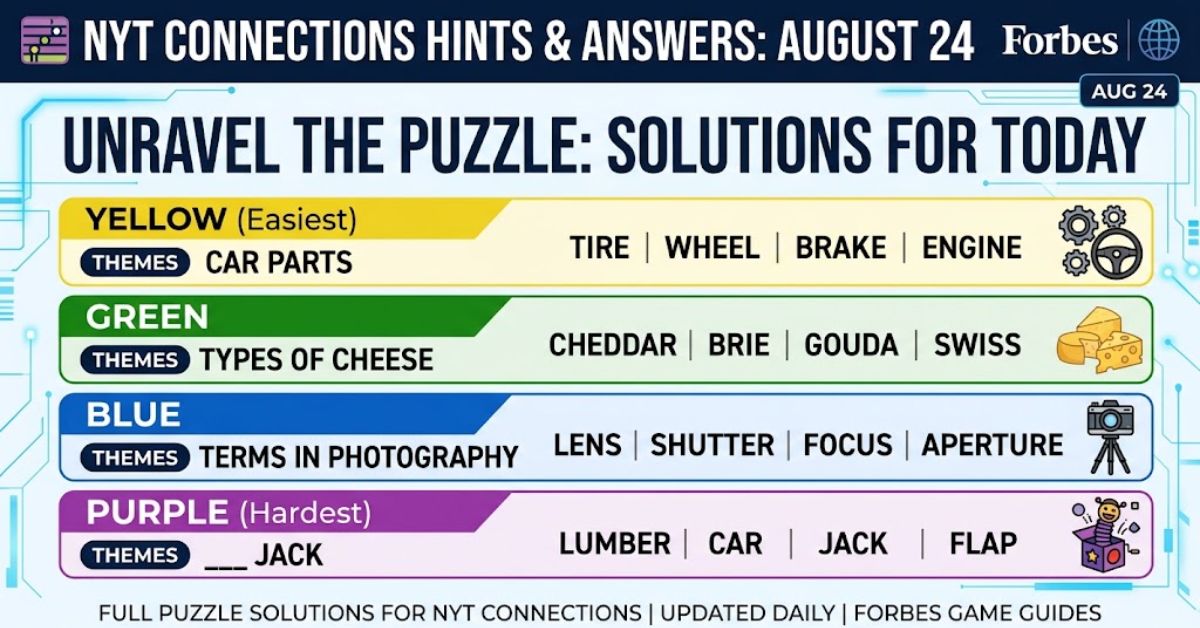
Connections Hints Forbes: NYT Connections Answers Today Aug 24
The New York Times Connections puzzle has become one of the most popular daily word games, challenging players to find hidden relationships between 16 words. Every day, players search for Connections Hints Forbes and similar guides to understand tricky categories, confirm answers, and improve their solving strategies.
For Monday, August 24, 2026, NYT Connections puzzle #1170 includes four unique categories covering fish names, words related to importance, professional wrestling vocabulary, and a creative wordplay category involving letter sounds. Some groups are straightforward, while others require careful thinking to avoid misleading connections.
This guide provides the complete Connections Hints Forbes breakdown, including today’s hints, answers, category explanations, and solving tips to help players understand how each group fits together.
What Are Today’s NYT Connections Hints?
NYT Connections gives players a grid of 16 words that must be separated into four groups of four. Each category has a different theme, and players need to identify the correct relationship between words before making four mistakes.
The puzzle uses a color-based difficulty system:
| Color Group | Difficulty Level | Purpose |
|---|---|---|
| Yellow | Easiest | Common connections that are usually direct |
| Green | Moderate | Requires understanding of meanings or usage |
| Blue | Difficult | Often based on specialized knowledge |
| Purple | Trickiest | Usually involves wordplay or unusual patterns |
The August 24 puzzle (#1170) uses a mix of everyday vocabulary and specialized terms. The yellow category focuses on aquatic animals, while the purple category challenges players with sound-based word combinations.
How the Connections Game Works
Players receive 16 words and must organize them into four groups. Each correct group contains four words sharing a specific connection.
A successful strategy is to:
- Identify obvious words first.
- Avoid grouping words based only on similar meanings.
- Look for alternative meanings of words.
- Save the most confusing category for last.
Many difficult puzzles include words that appear to belong together but actually fit another category.
Connections Hints Forbes: Today’s NYT Connections Categories Explained
The Connections Hints Forbes guide for August 24, 2026, highlights four categories. Each group contains four answers with a shared theme.
| Color | Category | Answers |
|---|---|---|
| Yellow | Fish | Mullet, Pike, Sole, Tang |
| Green | Principal | Arch, Chief, Main, Prime |
| Blue | Pro-Wrestling Lingo | Face, Heel, Jobber, Kayfabe |
| Purple | Letter Homophone + Tennis Term | Beset, Deserve, Ex-Love, Eyelet |
Understanding why each word belongs to its group makes the puzzle easier to solve and helps players recognize similar patterns in future games.
Yellow Group: Fish
The yellow category is usually designed as the easiest group, and today’s theme is fish. The four answers are:
- Mullet
- Pike
- Sole
- Tang
These words represent different types of fish found in oceans, rivers, and aquariums.
| Word | Fish Type |
|---|---|
| Mullet | A fish commonly found in coastal waters |
| Pike | A freshwater predatory fish |
| Sole | A flatfish often used as seafood |
| Tang | A colorful marine fish often seen in aquariums |
The challenge comes from the fact that some words have other meanings. For example, “sole” can mean the bottom of a shoe, and “tang” can describe a sharp taste. Recognizing their biological meanings is the key.
Green Group: Principal
The green group connects words that describe something important, leading, or primary.
The answers are:
- Arch
- Chief
- Main
- Prime
These words are often used to describe the most important part of something.
| Word | Meaning |
|---|---|
| Arch | Main or dominant, such as an arch-enemy |
| Chief | Highest in rank or importance |
| Main | Primary or central |
| Prime | Most important or excellent |
This category tests vocabulary knowledge because these words are commonly used in different contexts. “Arch” may look unrelated at first because many people associate it with architecture rather than meaning “principal.”
Blue Group: Pro-Wrestling Lingo
The blue category focuses on professional wrestling terminology. These words are familiar to wrestling fans but may be challenging for casual players.
The answers are:
- Face
- Heel
- Jobber
- Kayfabe
| Term | Wrestling Meaning |
|---|---|
| Face | A good or heroic wrestler |
| Heel | A villain or antagonist wrestler |
| Jobber | A wrestler who usually loses to build others |
| Kayfabe | The presentation of wrestling storylines as real |
Professional wrestling uses a unique vocabulary built around characters, storytelling, and performance. “Face” and “heel” describe character roles, while “kayfabe” refers to maintaining the illusion of scripted competition.
This category demonstrates how NYT Connections often includes niche topics that reward specialized knowledge.
Purple Group: Letter Homophone Plus Tennis Term
The purple category is usually the hardest because it involves wordplay. Today’s group combines words that sound like letters with tennis-related terms.
The answers are:
- Beset
- Deserve
- Ex-Love
- Eyelet
Each word can be separated into a letter sound plus a tennis term:
| Answer | Wordplay |
|---|---|
| Beset | B + set |
| Deserve | D + serve |
| Ex-Love | X + love |
| Eyelet | I + let |
This type of category requires players to think beyond normal definitions. Instead of asking what each word means, players must listen to how the word sounds.
NYT Connections #1170 Answers for Monday, August 24, 2026
For players who want the complete solution, here are all four groups from today’s puzzle.
| Category | Words |
|---|---|
| Fish | Mullet, Pike, Sole, Tang |
| Principal | Arch, Chief, Main, Prime |
| Pro-Wrestling Lingo | Face, Heel, Jobber, Kayfabe |
| Letter Homophone Plus Tennis Term | Beset, Deserve, Ex-Love, Eyelet |
The biggest traps in this puzzle come from words with multiple meanings. For example, “face” could describe appearance, “sole” could relate to shoes, and “main” could appear in several unrelated contexts.
How to Solve NYT Connections Puzzles Faster
Improving at Connections requires recognizing patterns rather than simply knowing definitions. Many successful players develop a consistent approach.
Start With the Most Obvious Category
The easiest group usually provides momentum. Once one category is removed, the remaining words become easier to analyze.
Try this process:
- Look for words that clearly share a topic.
- Remove the confirmed group mentally.
- Reevaluate remaining words.
- Search for unusual connections.
Avoid Common Word Traps
NYT Connections intentionally includes misleading words. A word may fit multiple possible categories, but only one relationship is correct.
Common mistakes include:
- Grouping words based only on similar meanings.
- Ignoring alternative definitions.
- Missing pop culture or specialized references.
- Solving the hardest category first.
Use a Final Checklist Before Submitting
Before locking in a category, ask:
- Do all four words have the exact same relationship?
- Could another word replace one of these answers?
- Is there a stronger connection elsewhere?
- Does the category explain all four words clearly?
Why Players Search for Connections Hints Forbes
Many players use daily guides like Connections Hints Forbes because they provide more than just answers. Good explanations help players understand puzzle construction and improve future performance.
Puzzle guides are especially useful when:
- A category uses uncommon vocabulary.
- A word has multiple meanings.
- A theme involves sports, entertainment, or technical terms.
- A player wants to learn solving techniques.
Instead of simply revealing answers, explanations show the reasoning behind each group.
Conclusion
The August 24, 2026 NYT Connections puzzle (#1170) combines simple vocabulary, specialized knowledge, and creative wordplay. The four categories include fish, principal-related terms, professional wrestling language, and tennis-inspired letter homophones.
Using guides like Connections Hints Forbes can help players understand difficult patterns while improving their own solving skills. Whether you solve independently or check explanations afterward, learning the reasoning behind each category makes future Connections puzzles more enjoyable and easier to complete.