RAADS-R Test: Understanding the Autism Diagnostic Tool
Autism spectrum disorder (ASD) is a complex neurological condition that affects social interaction, communication, and behavior. While early diagnosis in children is common, many adults remain undiagnosed or misdiagnosed for years. Enter the RAADS-R test—a critical assessment tool designed to identify autism in adults. Unlike traditional tests primarily geared toward children, RAADS-R is specifically tailored to capture the nuanced behaviors and thought patterns of adults on the spectrum.
In this article, we will explore the RAADS-R test in depth: its purpose, structure, benefits, limitations, and how it differs from other autism diagnostic tools. By the end, you’ll have a thorough understanding of why this test has become a go-to resource for clinicians and adults seeking answers.
What Is the RAADS-R Test?
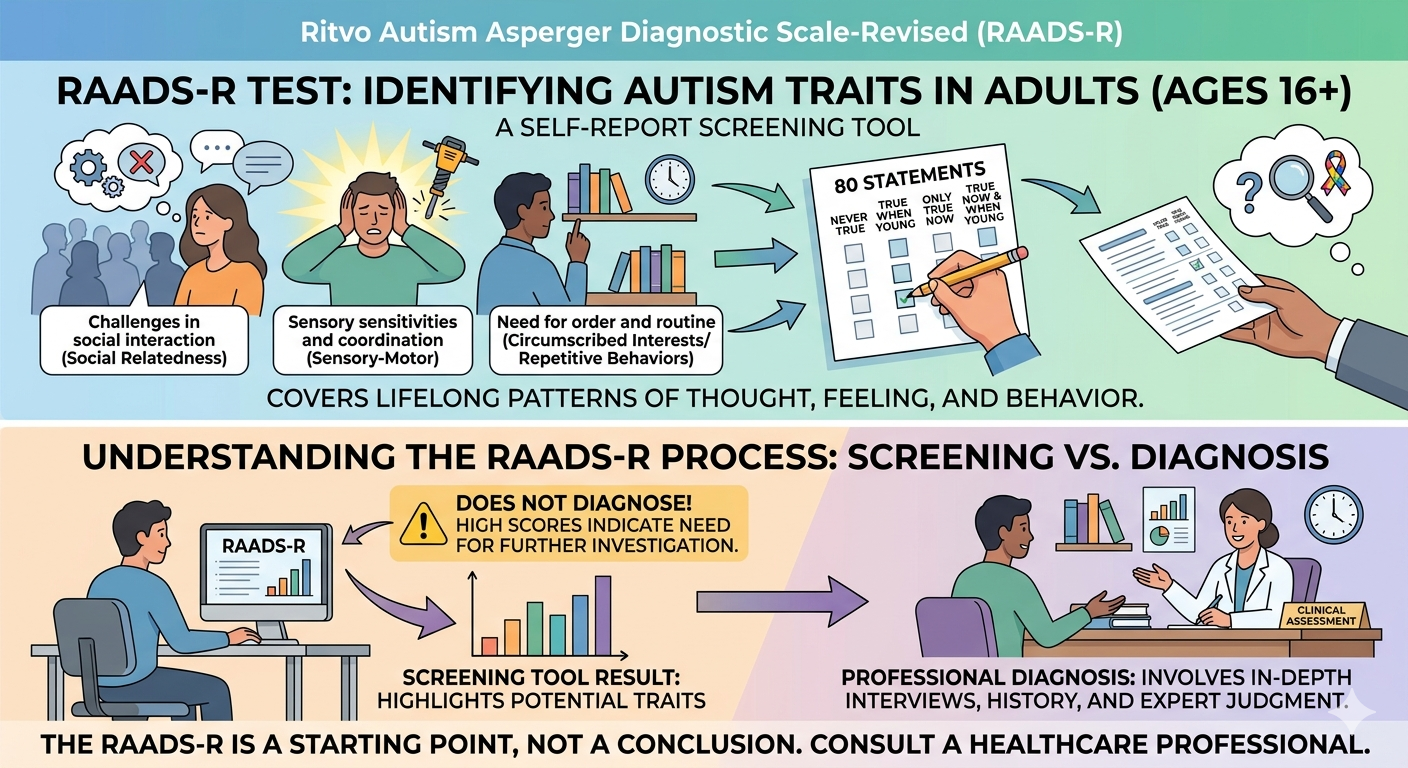
The RAADS-R test, short for the Ritvo Autism Asperger Diagnostic Scale-Revised, is a self-report and clinician-administered questionnaire developed to help identify adults who may have autism. Unlike many diagnostic tools that rely solely on observation, RAADS-R combines personal insight with clinical evaluation to provide a holistic assessment.
Originally developed by Dr. Ritvo and his team, RAADS-R focuses on the subtle manifestations of autism in adults, including:
- Social difficulties
- Communication challenges
- Sensory sensitivities
- Rigidity in behavior and thought
The test has been validated through research and clinical trials, demonstrating a high level of accuracy in identifying adults with ASD—even those who were undiagnosed during childhood.
Purpose of the RAADS-R Test
The RAADS-R test is not a definitive diagnosis on its own but serves several key purposes:
- Screening Adults for Autism: Many adults reach middle age without ever being diagnosed. RAADS-R helps identify those who might benefit from a formal evaluation.
- Supporting Clinicians: Clinicians can use RAADS-R results to complement behavioral observations and clinical interviews, making the diagnostic process more reliable.
- Self-Awareness: For individuals suspecting they may be on the autism spectrum, RAADS-R can provide valuable insights into patterns of behavior and thought processes.
- Research: RAADS-R is often used in clinical studies to understand autism traits in adults, helping researchers explore correlations with mental health, employment, and social functioning.
By offering a structured framework, the RAADS-R test bridges the gap between self-perceived symptoms and clinical diagnosis.
Structure of the RAADS-R Test
The RAADS-R test consists of 80 questions divided into four domains, each targeting a specific aspect of autism:
1. Social Relatedness
This section evaluates how individuals perceive and respond to social interactions. Questions focus on understanding social cues, making eye contact, and maintaining friendships. Adults with ASD may find this domain particularly challenging.
2. Circumscribed Interests
Autistic adults often exhibit intense interests in specific topics. This section assesses the presence and intensity of these interests, helping differentiate between typical hobbies and traits associated with ASD.
3. Language and Communication
Communication is more than just speaking—it includes tone, gestures, and understanding figurative language. This domain explores difficulties in verbal and non-verbal communication, such as challenges in reading sarcasm or metaphors.
4. Sensory-Motor
Many adults with autism experience sensory sensitivities or unusual motor behaviors. This section investigates responses to stimuli like light, sound, texture, and motion, as well as repetitive movements or habits.
How Is the RAADS-R Test Administered?
The RAADS-R test can be self-administered or conducted by a trained clinician. Here’s how it typically works:
- Questionnaire Completion: The individual answers 80 questions, rating their experiences on a scale from “true now and when I was young” to “never true.”
- Scoring: Responses are scored to identify patterns consistent with autism. Higher scores indicate a greater likelihood of ASD traits.
- Clinical Review: A clinician reviews the results in combination with the patient’s history, observations, and additional assessments to determine whether a formal diagnosis is appropriate.
The combination of self-reporting and clinical evaluation makes RAADS-R particularly useful for capturing traits that may not be obvious in a single clinical visit.
Benefits of the RAADS-R Test
The RAADS-R test offers several advantages over other diagnostic methods:
- Adult-Focused: Many autism tests are designed for children, missing subtler adult behaviors. RAADS-R addresses this gap.
- Comprehensive Domains: By covering social, communication, sensory, and interest-based traits, it offers a well-rounded assessment.
- Validated Tool: Research supports its reliability and accuracy for screening adults.
- Time-Efficient: It can often be completed in a single session, saving both clinicians’ and patients’ time.
These benefits make RAADS-R an appealing option for adults seeking clarity about their experiences.
Limitations of the RAADS-R Test
No test is perfect, and RAADS-R does have some limitations:
- Self-Reporting Bias: Some adults may underreport or overreport symptoms based on self-perception or denial.
- Not a Standalone Diagnosis: RAADS-R is a screening tool; a full clinical evaluation is necessary to confirm autism.
- Cultural Considerations: Social and communication norms vary across cultures, potentially affecting the accuracy of some questions.
- Overlap with Other Conditions: Traits like social anxiety or ADHD may resemble ASD features, complicating interpretation.
Despite these limitations, RAADS-R remains a valuable step in the diagnostic process, especially when combined with expert evaluation.
RAADS-R vs. Other Autism Assessments
Several tools exist for diagnosing autism, but RAADS-R stands out for adult assessment:
| Tool | Target Population | Focus | Pros | Cons |
|---|---|---|---|---|
| ADOS-2 | Children & adults | Observational behaviors | Highly standardized | Time-consuming |
| Autism Spectrum Quotient (AQ) | Adults | Self-report questionnaire | Quick and easy | Less detailed than RAADS-R |
| RAADS-R | Adults | Social, communication, sensory, interests | Adult-focused, comprehensive | Requires clinician interpretation |
In short, RAADS-R fills a critical niche for adults who may have been overlooked by childhood-focused tests.
Interpreting RAADS-R Scores
RAADS-R scoring can feel intimidating at first, but it’s relatively straightforward:
- Scores above a certain threshold indicate a high likelihood of ASD traits.
- Scores in the mid-range suggest that traits exist but may not meet diagnostic criteria on their own.
- Low scores typically indicate that ASD traits are unlikely.
It’s important to remember that these scores are not definitive diagnoses—they guide clinicians in deciding whether further evaluation is warranted.
Preparing for the RAADS-R Test
If you’re considering taking the RAADS-R test, here are some tips:
- Be Honest: Answer based on your genuine experiences, both now and in childhood.
- Reflect on Childhood: Early experiences can be as telling as current behaviors.
- Take Your Time: Don’t rush through the questionnaire; thoughtful responses improve accuracy.
- Seek Professional Guidance: Have a clinician review your results to understand what they mean in context.
Preparation helps ensure that the test yields the most accurate and useful insights.
Real-World Applications of RAADS-R
RAADS-R is used in various contexts:
- Clinical Settings: Psychologists and psychiatrists use it to screen adult patients.
- Research: Scientists studying adult autism traits often rely on RAADS-R data.
- Self-Assessment: Individuals curious about their neurological profile may complete the test as a first step toward formal evaluation.
The flexibility of RAADS-R makes it a versatile tool for both professionals and individuals seeking answers.
FAQs
Q1: Is RAADS-R test free?
A: The test is often available through clinicians or licensed research studies. Online versions may exist but should be approached cautiously, as professional interpretation is crucial.
Q2: How long does it take to complete the RAADS-R test?
A: Typically, it takes 30–45 minutes, depending on how much reflection is needed for each question.
Q3: Can RAADS-R diagnose autism?
A: No, it cannot provide a definitive diagnosis alone. It is a screening tool that must be interpreted alongside clinical evaluations.
Q4: Who can take the RAADS-R test?
A: The test is designed for adults, especially those suspected of having undiagnosed autism.
Q5: What if my score is high?
A: A high score suggests that further evaluation may be warranted. It’s not a diagnosis but indicates traits consistent with ASD.
Q6: Can RAADS-R be used for children?
A: No, it’s specifically designed for adults. Other tools like ADOS-2 are better suited for children.
Conclusion
The RAADS-R test is a groundbreaking tool for identifying autism in adults. By focusing on the unique challenges adults face—social difficulties, sensory sensitivities, communication struggles, and circumscribed interests—it fills a vital gap in autism diagnostics. While it isn’t a standalone diagnostic tool, RAADS-R offers crucial insights that guide clinicians and empower individuals seeking clarity about their neurological profile.
For adults who have long wondered if their experiences fit within the autism spectrum, RAADS-R provides a structured, research-backed starting point. Coupled with professional guidance, it opens the door to understanding, support, and a more fulfilling life.