Sunshine Skyway Bridge Collapse: A Tragedy That Changed Engineering and Safety Forever
The Sunshine Skyway Bridge collapse remains one of the most devastating transportation disasters in American history. This catastrophic event not only impacted the families who lost loved ones but also reshaped the way bridges are designed, built, and protected against unpredictable forces of nature. The collapse highlighted the vulnerabilities of infrastructure exposed to extreme weather and maritime hazards, prompting nationwide changes in safety standards.
In this article, we dive deep into the story of the Sunshine Skyway Bridge, the factors that led to its collapse, the immediate aftermath, and the lasting legacy that continues to influence civil engineering and public safety.
A Marvel of Modern Engineering
When the original Sunshine Skyway Bridge opened in 1954, it instantly became a symbol of innovation and progress. Spanning the entrance to Tampa Bay, Florida, it connected the thriving communities of St. Petersburg and Bradenton. The impressive structure stretched over miles of open water, offering drivers stunning views of the Gulf of Mexico while dramatically cutting travel time between cities.
Engineers designed the bridge with grace and elegance — long, sweeping spans supported by massive concrete piers. It was more than just a road; it was an architectural statement and economic lifeline for the region.
For nearly three decades, the Sunshine Skyway Bridge stood strong. Yet, despite its beauty and utility, it faced a hidden danger that would one day prove fatal.
Approaching Disaster: March 9, 1980
On the morning of March 9, 1980, conditions in Tampa Bay were deteriorating. A severe weather system, later known as a nor’easter, pushed high winds and heavy seas into the bay, creating treacherous conditions for vessels and infrastructure alike.
Among the ships navigating these dangerous waters was the MV Summit Venture, a 50,000‑ton freighter carrying tons of cargo. Visibility was poor, and the wind gusted violently, making steering difficult even for experienced mariners.
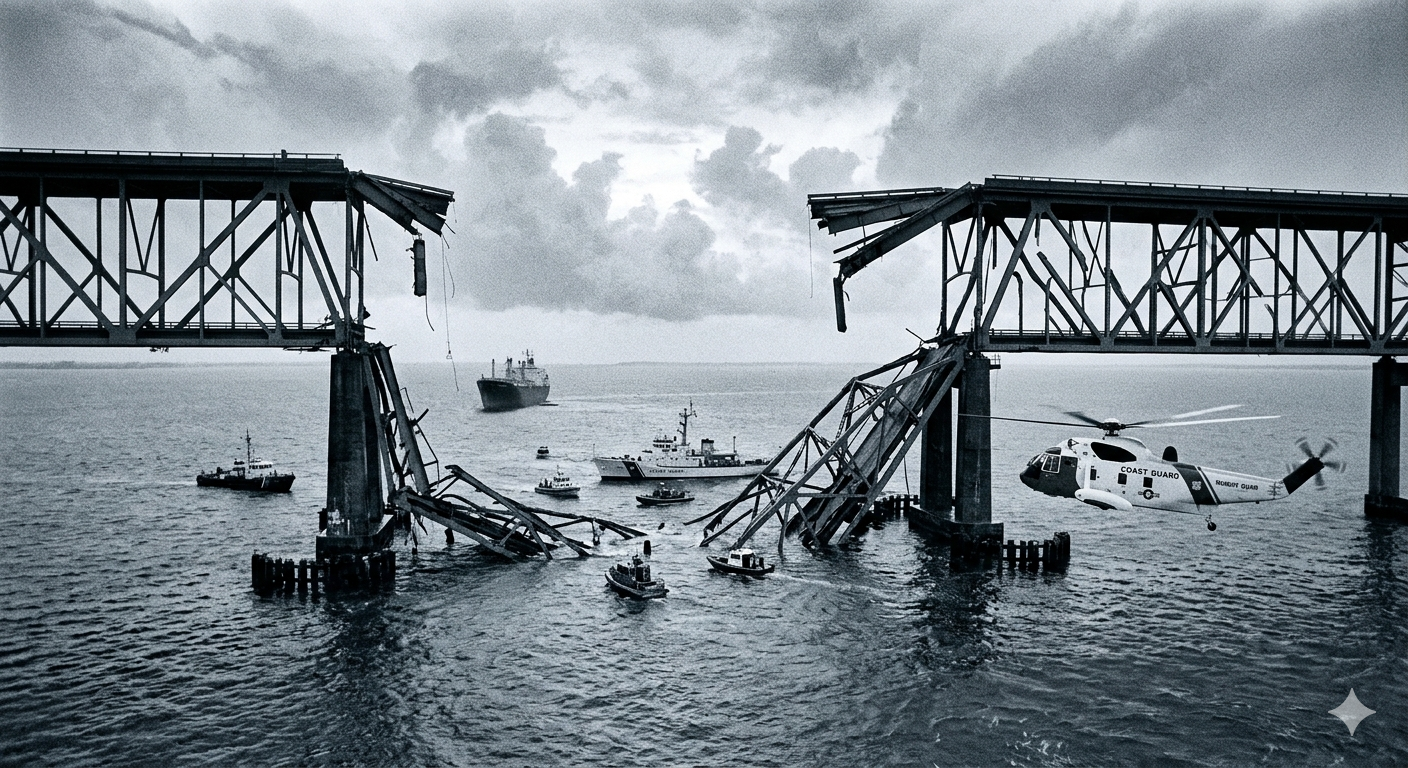
At approximately 7:38 a.m., the Summit Venture lost its course control and slammed directly into one of the bridge’s primary support columns — pier 13, located in the narrow channel under the central span. The impact was catastrophic. Within minutes, a 1,200‑foot section of the bridge — including the southbound lanes — collapsed into the tumultuous waters below.
Motorists driving at that moment had no warning. Several vehicles, including cars and a Greyhound bus, plunged into the bay. Emergency responders faced chaos: rough seas, stunned survivors, and the terrifying prospect of unstable bridge remnants.
By the time the rescue efforts concluded, 35 lives had been lost, many trapped beneath tangled steel and concrete or swept away by powerful currents.
Human Stories Behind the Statistics
It’s easy to list numbers and dates, but behind every statistic was a human life — someone who had a story, a family, and dreams cut tragically short.
Among the victims was a young couple on their way to start a new chapter of their life together. There were commuters, travelers passing through, and a bus full of passengers simply moving through their day when disaster struck.
Survivors recounted moments of terror: cars teetering on the edge, frantic calls for help, and strangers working together in the water to pull one another to safety. Those who lived through the collapse carried emotional scars that lasted decades, a reminder of how swiftly ordinary life can turn into tragedy.
Families of the deceased also fought for answers, demanding accountability and improvements to prevent future loss. Their voices became part of the movement that changed bridge safety forever.
Response and Rescue: What Happened Next
Rescuers — including local law enforcement, Coast Guard crews, volunteer boaters, and everyday citizens — raced against time to save lives. Despite fierce winds and turbulent waves, they worked tirelessly.
Boats maneuvered close to unstable bridge fragments. Lifeguards plunged repeatedly into the cold water. Helicopters circled overhead, assisting where possible. In many cases, ordinary people became heroes, pulling survivors from the water and caring for the injured on the shore.
It was an all‑hands‑on‑deck moment that showcased human bravery in the face of disaster. Search teams worked through the night, but as dawn broke, hope faded for those still missing.
The aftermath brought grief, shock, and profound questions about how such a collapse could occur.
Investigation: Why Did It Happen?
Once the immediate rescue efforts subsided, investigations began to determine the cause and scope of the disaster. Authorities combed through debris, interviewed witnesses, and studied weather and navigational data.
The conclusion was sobering: the bridge’s support piers were not sufficiently protected against a direct impact from a large ship. While the structure itself was sound and had endured countless storms, the vulnerability lay in the absence of protective systems — especially in the narrow channel where vessels passed.
The investigation underscored a critical point: a bridge might be engineered to withstand natural forces, but unexpected human or mechanical error — such as a ship straying off course — needs to be accounted for in design.
The collapse revealed that assumptions about safe navigation zones and bridge protection were no longer enough.
Rebuilding: From Tragedy to Triumph
Despite the tragedy, the Sunshine Skyway story did not end in defeat. Public officials, engineers, and community leaders united with a shared mission: to build a safer, stronger bridge that would stand as a tribute to those lost and a testament to human resilience.
Construction of the new Sunshine Skyway Bridge began in 1982. Engineers adopted state‑of‑the‑art design principles, creating a structure that was not only visually striking but also significantly more robust. The new bridge incorporated:
- Massive concrete barriers around support piers to protect against ship collisions
- Longer, higher spans to allow larger vessels to pass safely underneath
- Advanced navigation and warning systems to guide ships through the channel
By 1987, the new Sunshine Skyway Bridge was complete, opening to traffic with both relief and reverence. Unlike its predecessor, this structure stood ready to withstand the unpredictable challenges posed by nature and man.
Today, it remains an iconic Florida landmark — a symbol of beauty, strength, and perseverance.
Engineering Lessons and Safety Standards
The collapse of the Sunshine Skyway Bridge prompted significant changes in civil engineering and infrastructure safety. The disaster highlighted key lessons:
1. Importance of Redundant Protection
Engineers learned that bridges spanning active shipping channels must include additional protective systems — such as breakaway barriers, fendering systems, and reinforced piers — to absorb or deflect ship impacts.
2. Navigation Aids and Monitoring
Coordinated systems of radars, signals, and real‑time tracking help ships maintain safe courses. These systems reduce the risk of navigational error, especially in poor weather.
3. Emergency Response Planning
Infrastructure projects now include detailed emergency response strategies. Local authorities train regularly for rapid deployment in worst‑case scenarios.
4. Risk Assessment in Design
Engineering no longer focuses only on structural loads from weather and traffic. Risk from external human or mechanical influence — like ship collisions or aircraft impact — must also be evaluated.
These lessons have since been applied not just at the Sunshine Skyway but around the world, shaping how bridges, tunnels, and waterways coexist safely.
Commemoration and Legacy
Every year, communities in Florida remember the victims of the Sunshine Skyway Bridge collapse. Memorial services, plaques, and quiet reflections honor those who lost their lives.
The site itself has become a place not of sorrow alone, but of remembrance and learning. Visitors coming to view the modern bridge are often struck by its elegance, unaware that beneath its graceful lines lies a story of loss, resilience, and renewed purpose.
Meanwhile, professionals in engineering and safety gather at conferences, study case files, and teach future generations about the importance of vigilance, innovation, and human compassion.
The Sunshine Skyway Bridge may be steel and concrete, but its true legacy lives in the hearts and minds of those who witnessed its fall and helped build it back stronger.
FAQs
Q1: What exactly caused the Sunshine Skyway Bridge to collapse?
The collapse was caused when the freighter MV Summit Venture lost navigational control during a severe storm and collided with one of the bridge’s support piers, leading to the failure of a central span. Poor visibility and extreme weather contributed to the ship veering off course.
Q2: How many people died in the Sunshine Skyway Bridge collapse?
A total of 35 people lost their lives when vehicles fell into the bay after the bridge span collapsed. This number includes drivers, passengers, and occupants of a Greyhound bus.
Q3: Was the original bridge unsafe?
The original bridge was not inherently unsafe under normal conditions; it was structurally sound for weather and traffic loads. However, it lacked sufficient protective barriers around its support piers to withstand a direct ship collision.
Q4: When was the new Sunshine Skyway Bridge completed?
The new and safer Sunshine Skyway Bridge was completed and opened to traffic in 1987, about seven years after the collapse.
Q5: Are there special safety features on the new bridge?
Yes. The redesigned bridge includes large protective barriers around piers, higher clearance for ships, and modern navigational aids to reduce the risk of collision.
Q6: Why is the Sunshine Skyway Bridge important today?
Beyond its vital role in transportation, the Sunshine Skyway Bridge stands as a reminder of the importance of engineering that accounts for both natural forces and human error. It symbolizes resilience and the human capacity to rebuild stronger after tragedy.
Q7: Can ships still pass under the Sunshine Skyway Bridge?
Absolutely. The new bridge was designed with sufficient clearance to allow large commercial ships to pass safely underneath without risk of collision under normal navigational guidance.
Q8: Has this kind of disaster happened elsewhere?
Similar bridge impact incidents have occurred globally, but each has led to advances in protective design, monitoring systems, and regulatory practices in maritime and civil engineering.
Conclusion
The Sunshine Skyway Bridge collapse was an unforgettable tragedy that reshaped American infrastructure forever. It’s a story of loss, yes — but also a story of courage, innovation, and transformation.
From the deep waters of Tampa Bay emerged lessons that have protected countless lives and guided engineers around the world. The modern Sunshine Skyway Bridge stands today not just as a route across water but as a testament to human determination to learn from the past and build safer futures.